Financial Assistance for Eligible Patients
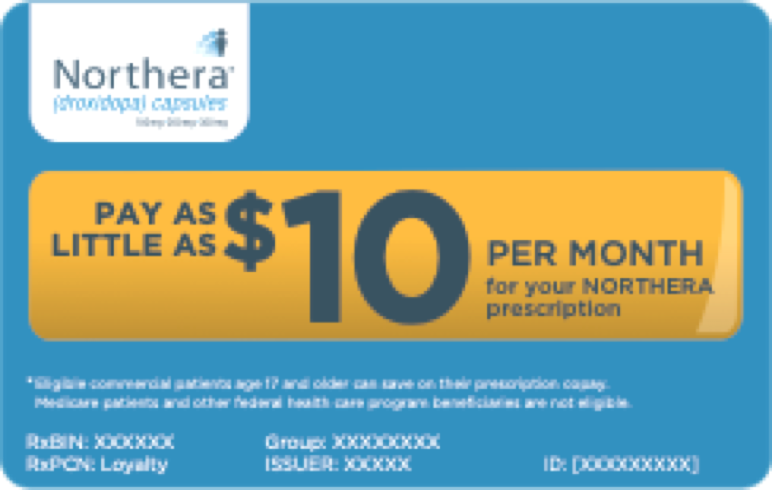
NORTHERA® (droxidopa) Commercial Copay Savings Program
NORTHERA’s Commercial Copay Savings Program can help eligible commercially insured patients with their copay.
Image above is not an actual Commercial Copay Savings Card. Note that a physical card is not sent to participants but instead available electronically and should be printed or the information written for your records. This information should be shared with the Specialty Pharmacy each time a prescription is filled.
Eligibility criteria and a program benefit limit apply. This offer is NOT available for people enrolled in Medicare, Medicaid, or any other government healthcare program. Coverage may vary from state to state; your state may or may not allow use of the copay card if a generic is available. Please see the full Terms and Conditions.
Please contact the Northera Support Center with any questions at 1-844-601-0101, Monday - Friday, 8 AM - 6 PM EST.
Please see Important Safety Information, including Boxed Warning for supine hypertension.
For more information, see the full Prescribing Information.
Use
NORTHERA (droxidopa) is a prescription medication used to reduce dizziness, lightheadedness, or the “feeling that you are about to black out” in adults who experience a significant drop in blood pressure when changing positions or standing (called symptomatic neurogenic orthostatic hypotension (nOH)) and who have one of the following:
- Parkinson’s disease (PD), a neurodegenerative disease that causes slowness in muscle movement as well as shaking in the hands
- Multiple system atrophy (MSA), a Parkinson’s-like disorder with more widespread effects on the brain and body
- Pure autonomic failure (PAF), a neurodegenerative disease that results in frequent drops in blood pressure upon standing
- Dopamine beta-hydroxylase deficiency, a condition where the body cannot make enough of the hormones that help regulate blood pressure
- Non-diabetic autonomic neuropathy, an inability to maintain blood pressure upon standing that can be caused by a number of rare diseases
Effectiveness beyond 2 weeks of treatment has not been established, and your doctor will decide if you should continue taking NORTHERA.
IMPORTANT SAFETY INFORMATION
WARNING: SUPINE HYPERTENSION (this is high blood pressure while lying down)
When lying down, elevating the head and upper body lowers the risk of high blood pressure. Check your blood pressure in this position prior to starting and during NORTHERA treatment. If you experience high blood pressure, talk to your doctor about your NORTHERA treatment.
- Do not take NORTHERA if you have a known allergy to NORTHERA or its ingredients.
- NORTHERA may cause high blood pressure when lying down, which could lead to strokes, heart attacks, and death. To reduce this risk of supine hypertension, take your late afternoon dose of NORTHERA at least 3 hours before going to bed.
- Neuroleptic malignant syndrome (NMS) is a rare but potentially life-threatening side effect reported with NORTHERA. Call your doctor right away and go to the nearest emergency room if you develop these signs and symptoms: high fever, stiff muscles, movements that you cannot control, confusion or problems thinking, very fast or uneven heartbeats, or increased sweating. NORTHERA should be stopped immediately if NMS is diagnosed.
- If you have coronary artery disease, irregular heartbeat, or heart failure, NORTHERA may worsen the symptoms of these disorders. Call your doctor if your symptoms become worse.
- NORTHERA may cause allergic reactions. Stop taking NORTHERA and contact your doctor right away, or go to the nearest emergency room if you experience any signs or symptoms of an allergic reaction such as: fast heartbeat, nausea, vomiting, swelling, trouble breathing, hives, or rash. NORTHERA contains tartrazine (FD&C Yellow No. 5), which may also cause an allergic reaction, especially if you have had a reaction to aspirin.
- The most common side effects with NORTHERA are headache, dizziness, nausea, and high blood pressure.
- Taking NORTHERA with other medications may cause side effects. Tell your doctor if you take prescription or over-the-counter medicines, vitamins, or herbal supplements.
- You should not breastfeed during treatment with NORTHERA.
- If you plan to become or are currently pregnant, talk to your doctor as it is not known if NORTHERA could harm your unborn baby.
- Take NORTHERA the same way each time, either with or without food.
- If you miss a dose of NORTHERA, take your next dose at the regularly scheduled time. Do not double the dose.
For more information, please see the full Prescribing Information, including Boxed Warning for supine hypertension.
You are encouraged to report negative side effects of prescription drugs to the FDA. Visit www.fda.gov/medwatch, or call 1-800-FDA-10881-800-FDA-1088.
Please see Important Safety Information, including Boxed Warning for supine hypertension.
For more information, see the full Prescribing Information.
The product information provided in this site is intended only for residents of the US. The health information contained herein is provided for educational purposes only and is not intended to replace discussions with a healthcare provider.
©2026 Lundbeck. All rights reserved. NORTHERA is a registered trademark of Lundbeck NA Ltd.
DRX-B-100477

Use
NORTHERA (droxidopa) is a prescription medication used to reduce dizziness, lightheadedness, or the “feeling that you are about to black out” in adults who experience a significant drop in blood pressure when changing positions or standing (called symptomatic neurogenic orthostatic hypotension (nOH)) and who have one of the following:
- Parkinson’s disease (PD), a neurodegenerative disease that causes slowness in muscle movement as well as shaking in the hands
- Multiple system atrophy (MSA), a Parkinson’s-like disorder with more widespread effects on the brain and body
- Pure autonomic failure (PAF), a neurodegenerative disease that results in frequent drops in blood pressure upon standing
- Dopamine beta-hydroxylase deficiency, a condition where the body cannot make enough of the hormones that help regulate blood pressure
- Non-diabetic autonomic neuropathy, an inability to maintain blood pressure upon standing that can be caused by a number of rare diseases
Effectiveness beyond 2 weeks of treatment has not been established, and your doctor will decide if you should continue taking NORTHERA.
IMPORTANT SAFETY INFORMATION
WARNING: SUPINE HYPERTENSION (this is high blood pressure while lying down)
When lying down, elevating the head and upper body lowers the risk of high blood pressure. Check your blood pressure in this position prior to starting and during NORTHERA treatment. If you experience high blood pressure, talk to your doctor about your NORTHERA treatment.
- Do not take NORTHERA if you have a known allergy to NORTHERA or its ingredients.
- NORTHERA may cause high blood pressure when lying down, which could lead to strokes, heart attacks, and death. To reduce this risk of supine hypertension, take your late afternoon dose of NORTHERA at least 3 hours before going to bed.
- Neuroleptic malignant syndrome (NMS) is a rare but potentially life-threatening side effect reported with NORTHERA. Call your doctor right away and go to the nearest emergency room if you develop these signs and symptoms: high fever, stiff muscles, movements that you cannot control, confusion or problems thinking, very fast or uneven heartbeats, or increased sweating. NORTHERA should be stopped immediately if NMS is diagnosed.
- If you have coronary artery disease, irregular heartbeat, or heart failure, NORTHERA may worsen the symptoms of these disorders. Call your doctor if your symptoms become worse.
- NORTHERA may cause allergic reactions. Stop taking NORTHERA and contact your doctor right away, or go to the nearest emergency room if you experience any signs or symptoms of an allergic reaction such as: fast heartbeat, nausea, vomiting, swelling, trouble breathing, hives, or rash. NORTHERA contains tartrazine (FD&C Yellow No. 5), which may also cause an allergic reaction, especially if you have had a reaction to aspirin.
- The most common side effects with NORTHERA are headache, dizziness, nausea, and high blood pressure.
- Taking NORTHERA with other medications may cause side effects. Tell your doctor if you take prescription or over-the-counter medicines, vitamins, or herbal supplements.
- You should not breastfeed during treatment with NORTHERA.
- If you plan to become or are currently pregnant, talk to your doctor as it is not known if NORTHERA could harm your unborn baby.
- Take NORTHERA the same way each time, either with or without food.
- If you miss a dose of NORTHERA, take your next dose at the regularly scheduled time. Do not double the dose.
For more information, please see the full Prescribing Information, including Boxed Warning for supine hypertension.
You are encouraged to report negative side effects of prescription drugs to the FDA. Visit www.fda.gov/medwatch, or call 1-800-FDA-10881-800-FDA-1088.